Luna and the Solar System Map
Join Luna as she explores the Sun, eight planets, moons, asteroids, comets, and gravity on a child-friendly science adventure.
Ages 6–10 years · 8 min · 20 scenes
The Journey Begins
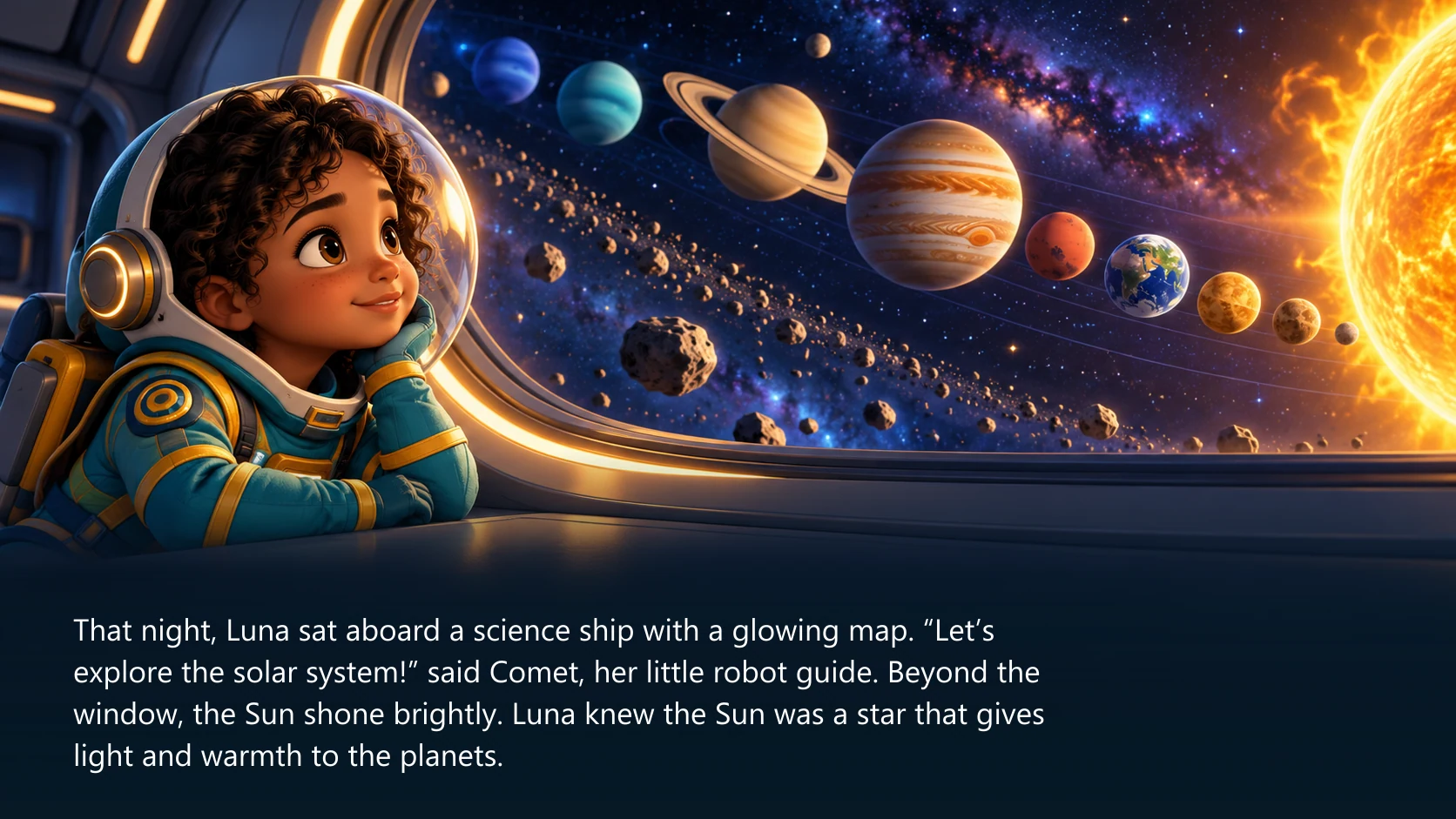
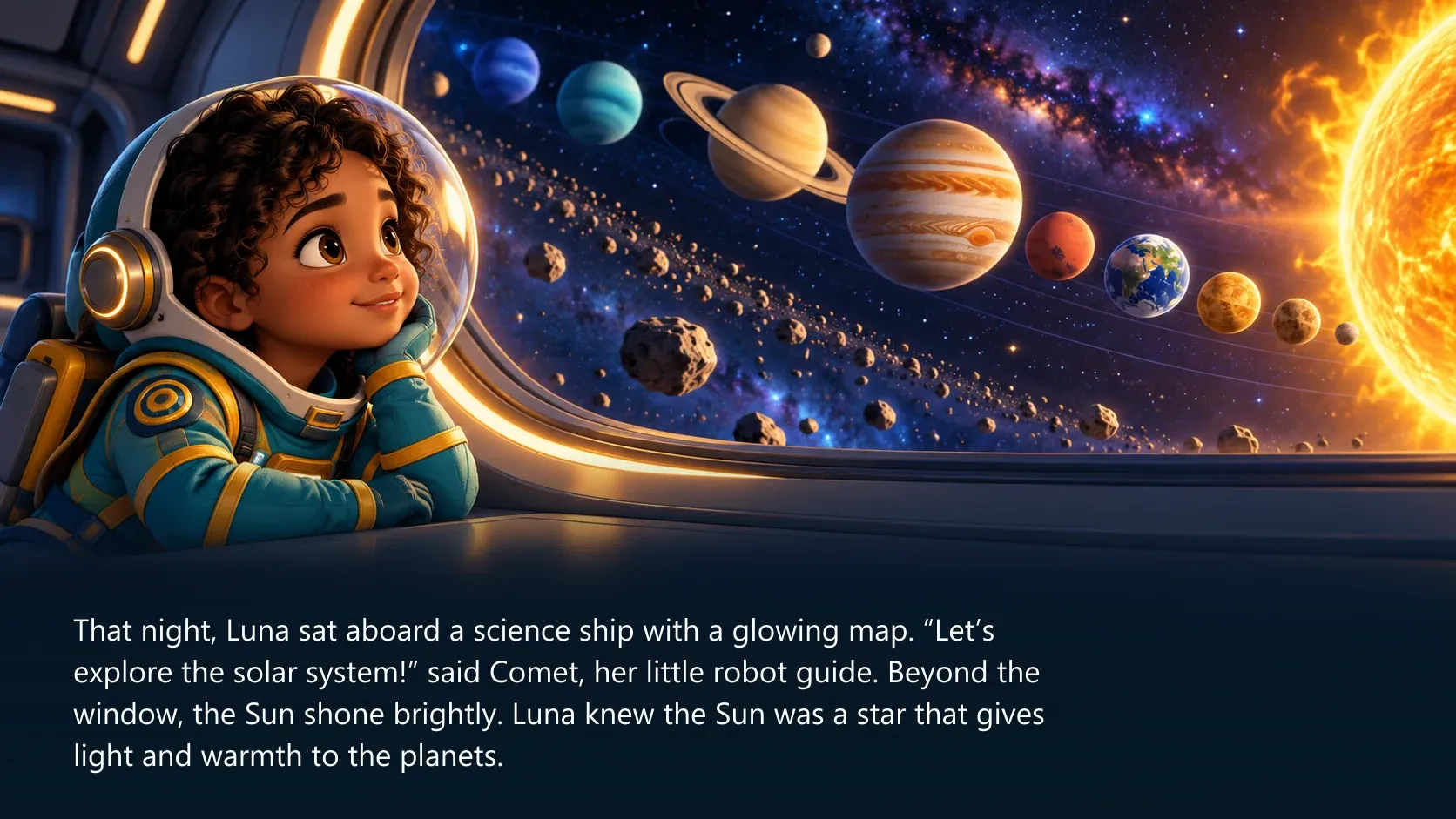
That night, Luna sat aboard a science ship with a glowing map. “Let’s explore the solar system!” said Comet, her little robot guide. Beyond the window, the Sun shone brightly. Luna knew the Sun was a star that gives light and warmth to the planets.
Mercury Near the Sun
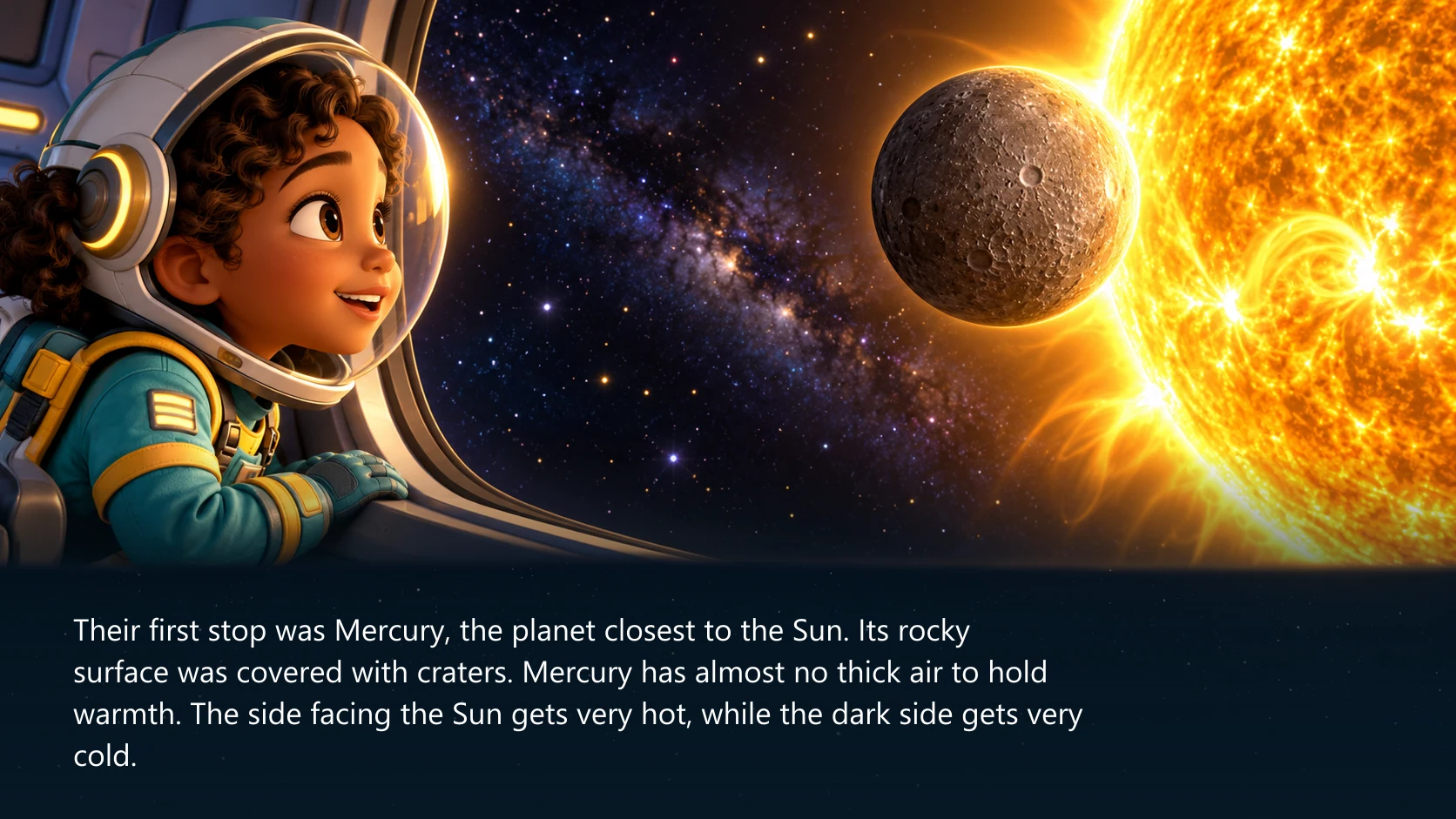
Their first stop was Mercury, the planet closest to the Sun. Its rocky surface was covered with craters. Mercury has almost no thick air to hold warmth. The side facing the Sun gets very hot, while the dark side gets very cold.
Venus and Its Thick Clouds
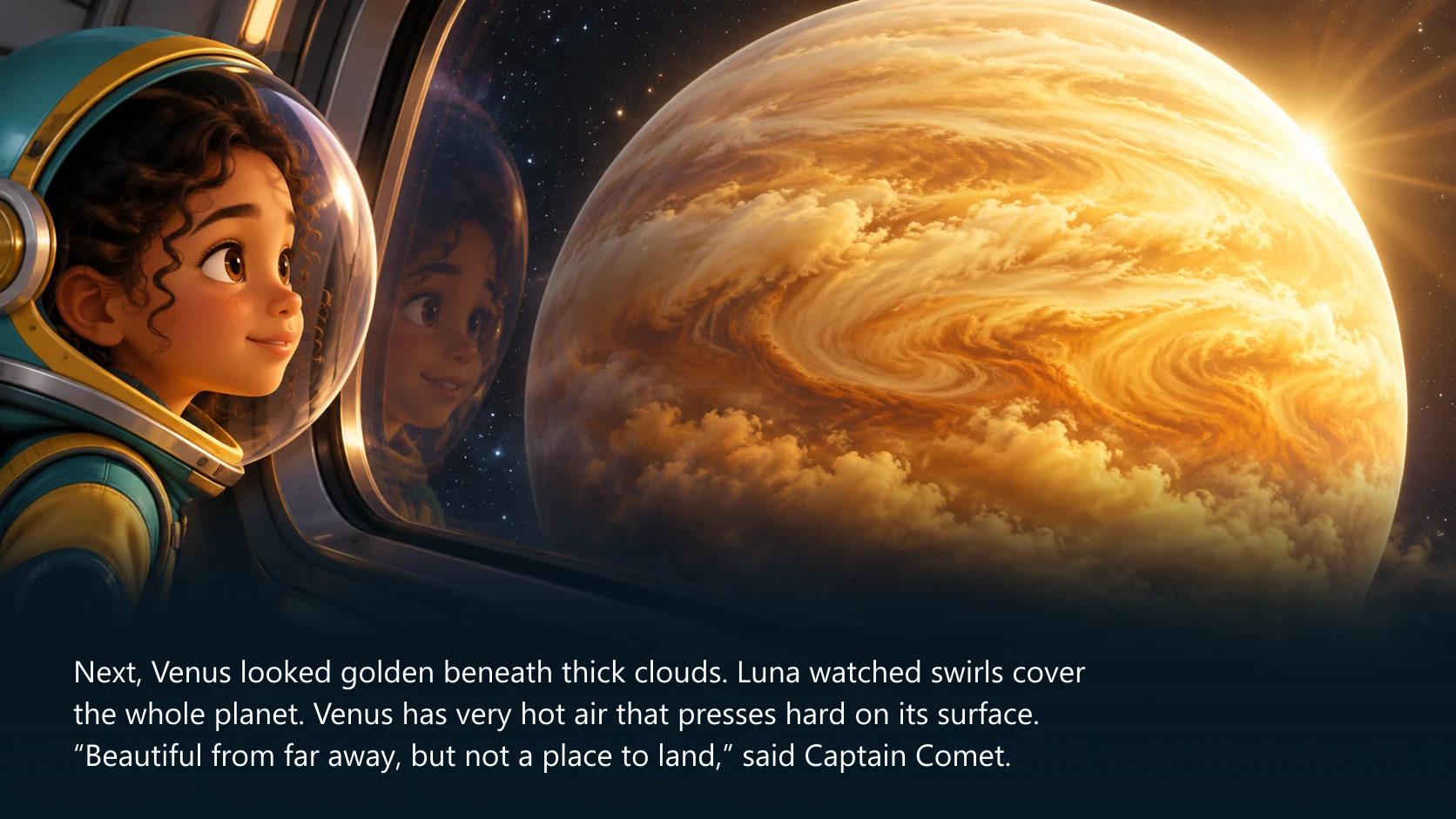
Next, Venus looked golden beneath thick clouds. Luna watched swirls cover the whole planet. Venus has very hot air that presses hard on its surface. “Beautiful from far away, but not a place to land,” said Captain Comet.
Earth, Our Home
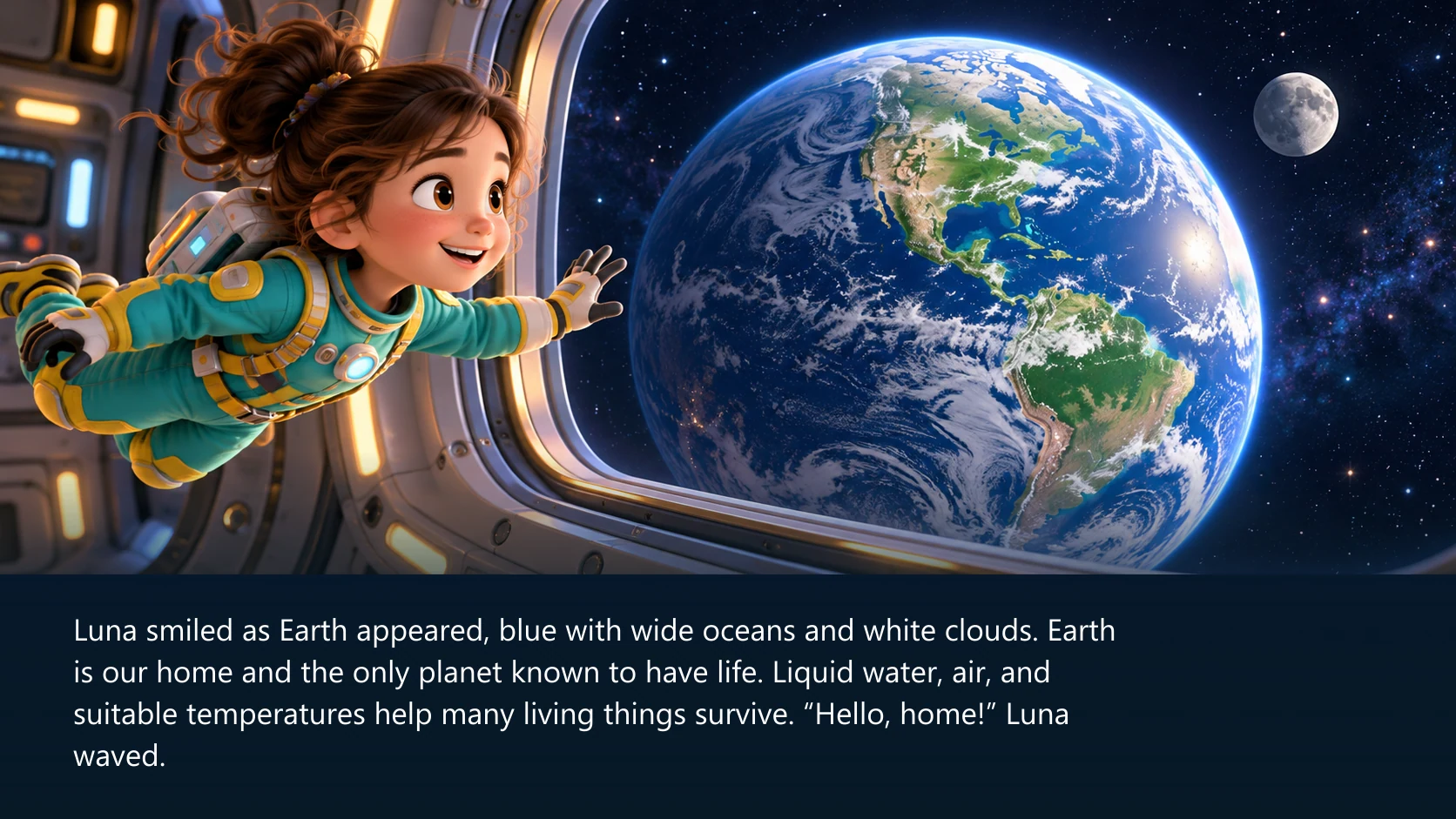
Luna smiled as Earth appeared, blue with wide oceans and white clouds. Earth is our home and the only planet known to have life. Liquid water, air, and suitable temperatures help many living things survive. “Hello, home!” Luna waved.
The Moon Travels with Earth
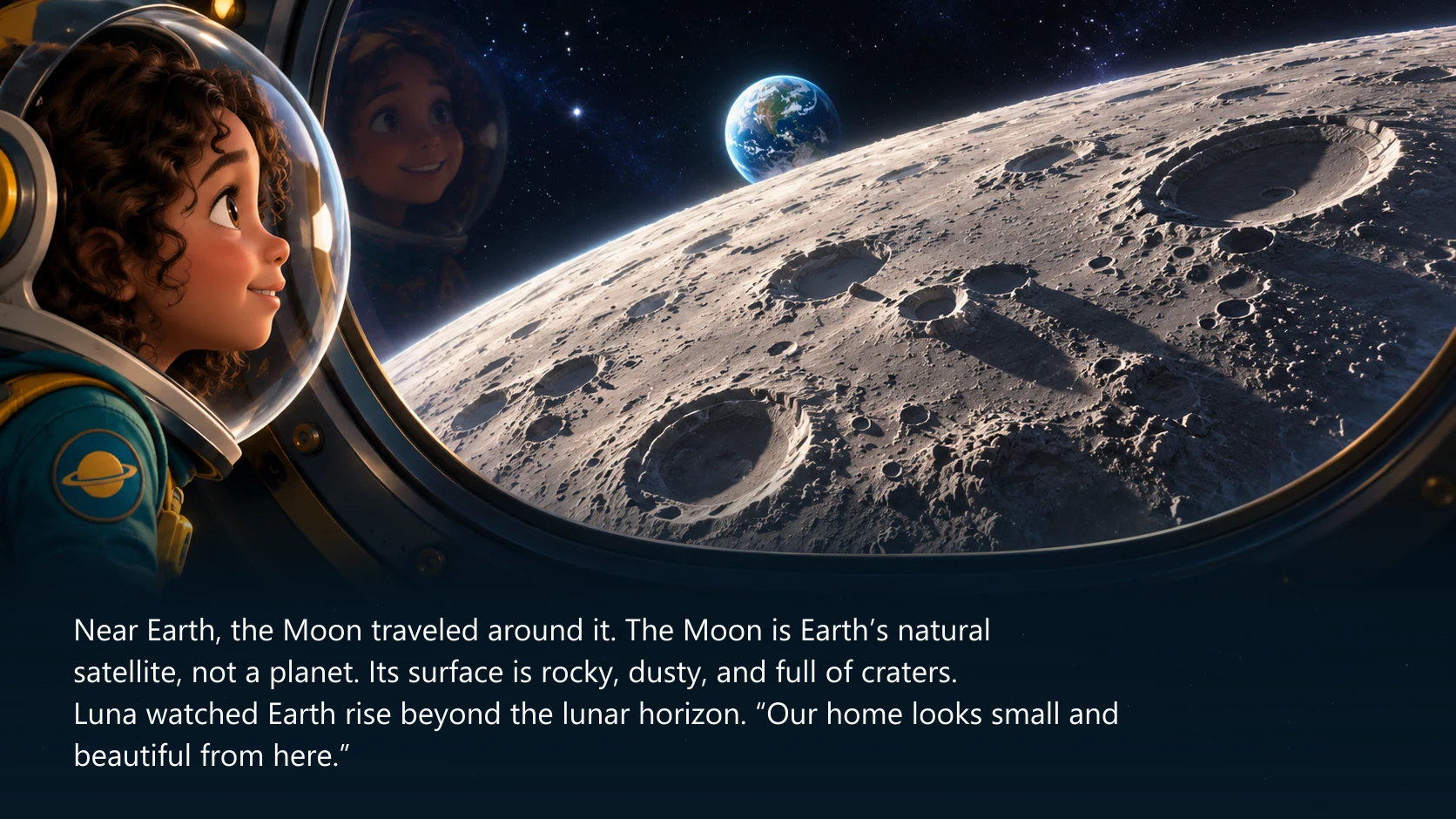
Near Earth, the Moon traveled around it. The Moon is Earth’s natural satellite, not a planet. Its surface is rocky, dusty, and full of craters. Luna watched Earth rise beyond the lunar horizon. “Our home looks small and beautiful from here.”
Red Mars
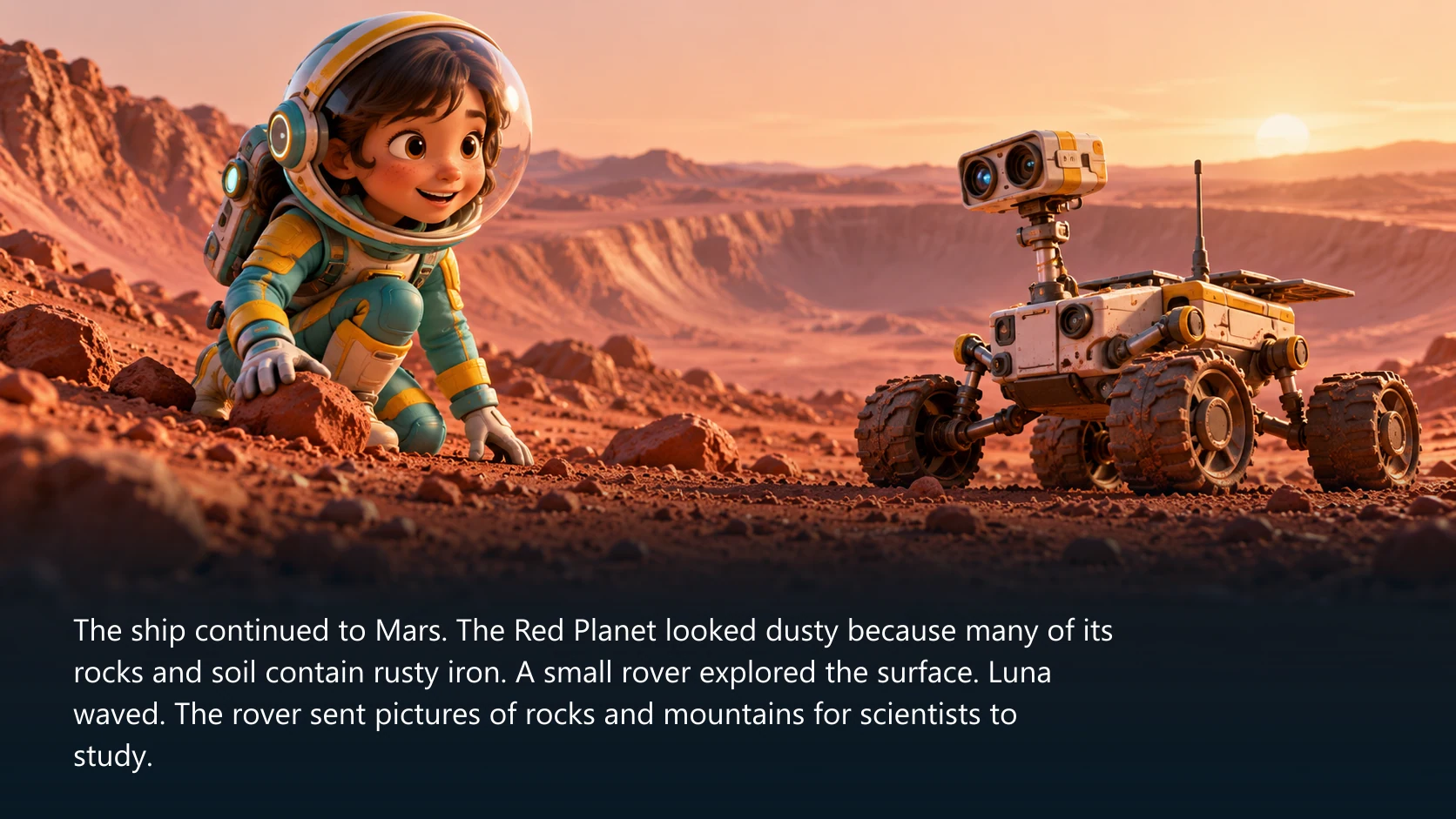
The ship continued to Mars. The Red Planet looked dusty because many of its rocks and soil contain rusty iron. A small rover explored the surface. Luna waved. The rover sent pictures of rocks and mountains for scientists to study.
The Asteroid Belt
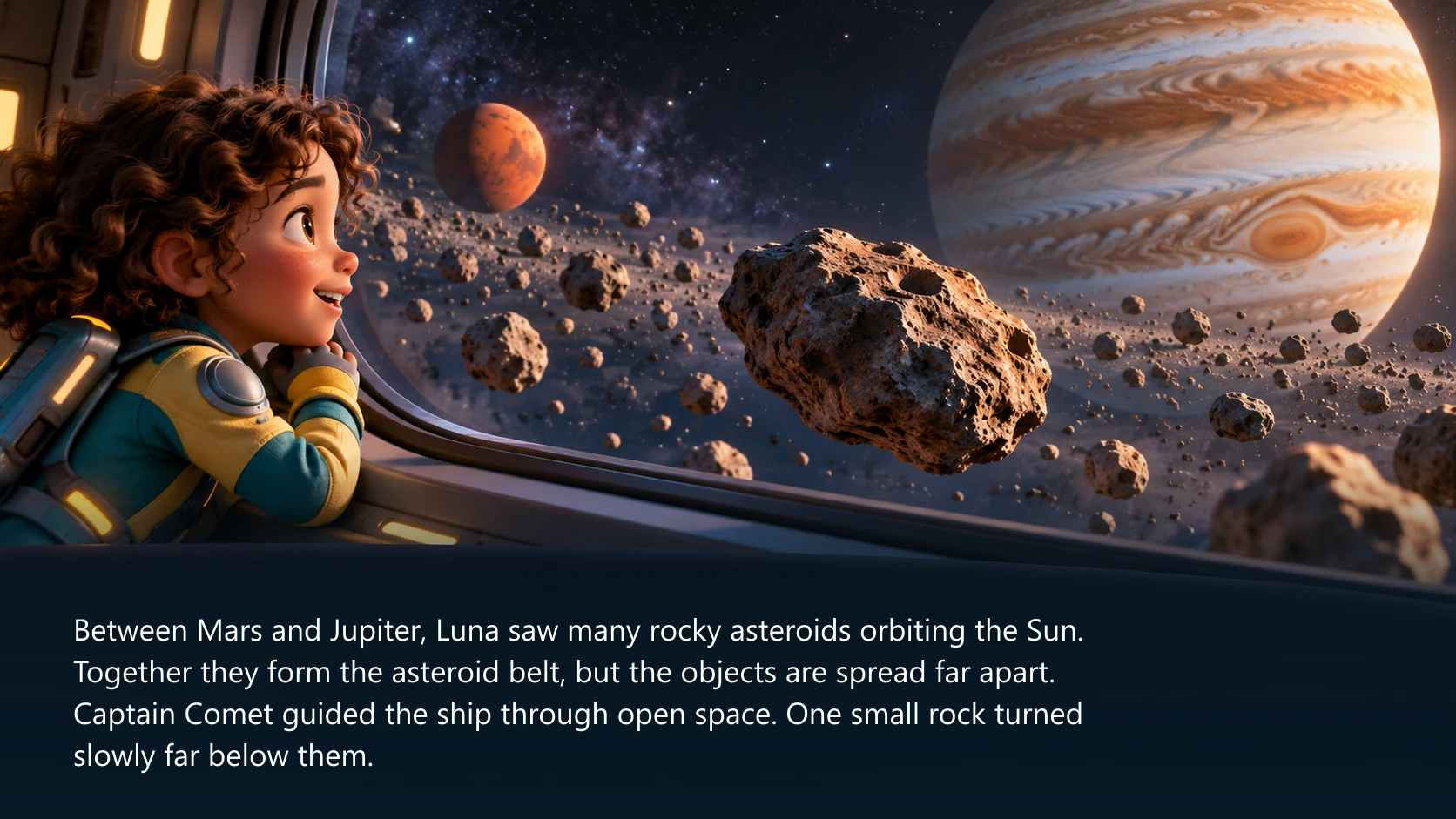
Between Mars and Jupiter, Luna saw many rocky asteroids orbiting the Sun. Together they form the asteroid belt, but the objects are spread far apart. Captain Comet guided the ship through open space. One small rock turned slowly far below them.
Giant Jupiter
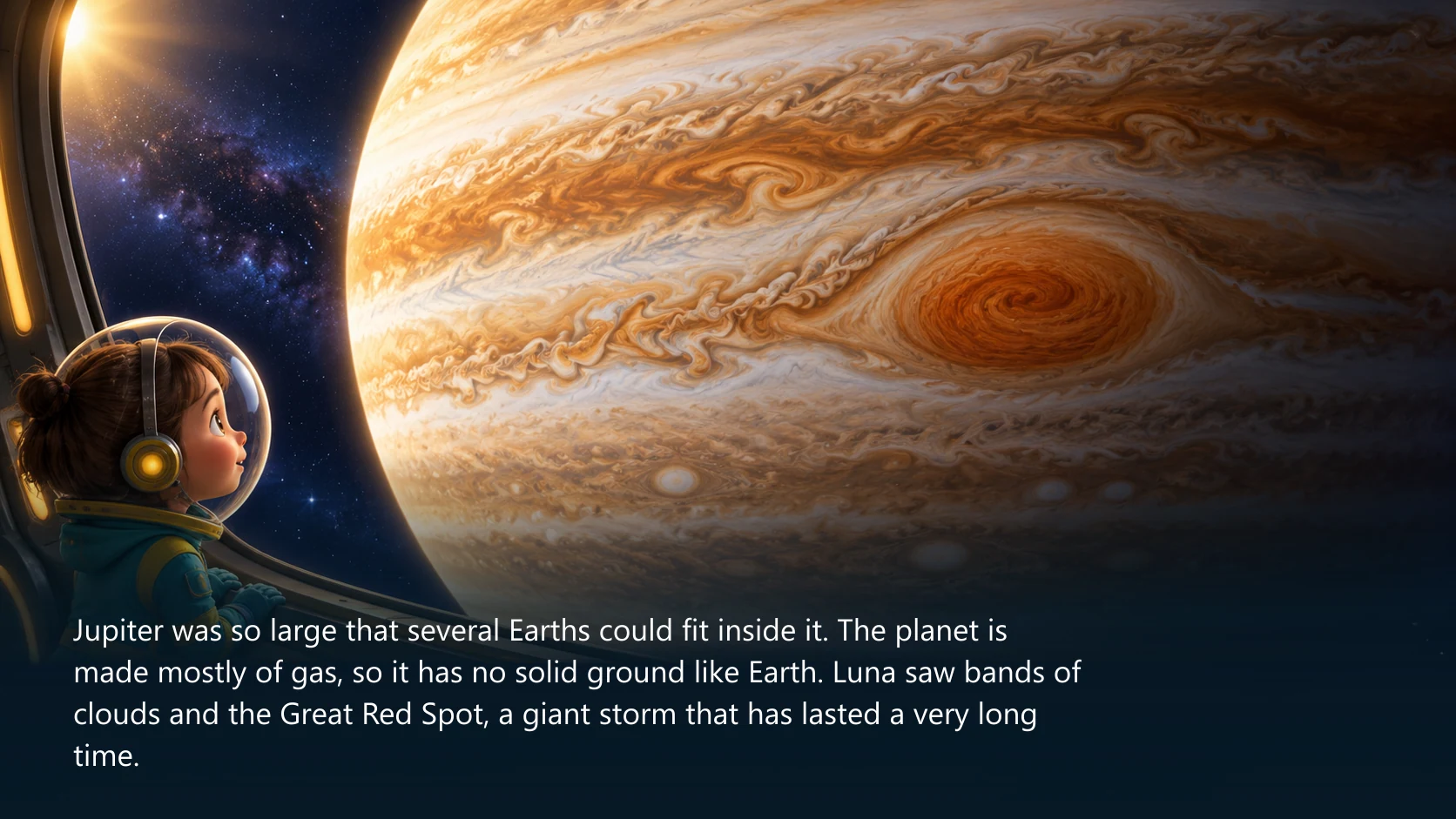
Jupiter was so large that several Earths could fit inside it. The planet is made mostly of gas, so it has no solid ground like Earth. Luna saw bands of clouds and the Great Red Spot, a giant storm that has lasted a very long time.
Europa, the Icy Moon
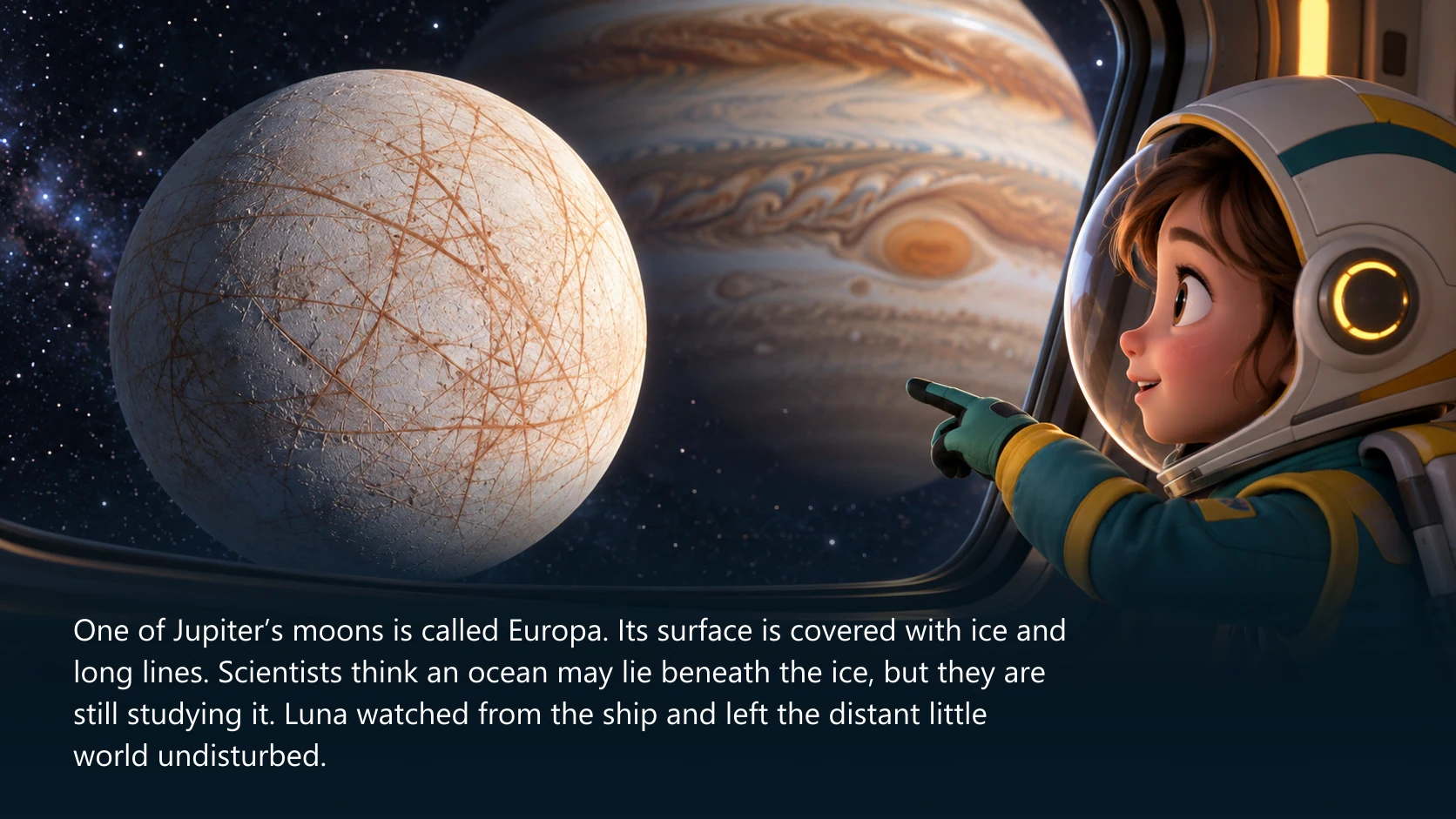
One of Jupiter’s moons is called Europa. Its surface is covered with ice and long lines. Scientists think an ocean may lie beneath the ice, but they are still studying it. Luna watched from the ship and left the distant little world undisturbed.
Saturn’s Rings
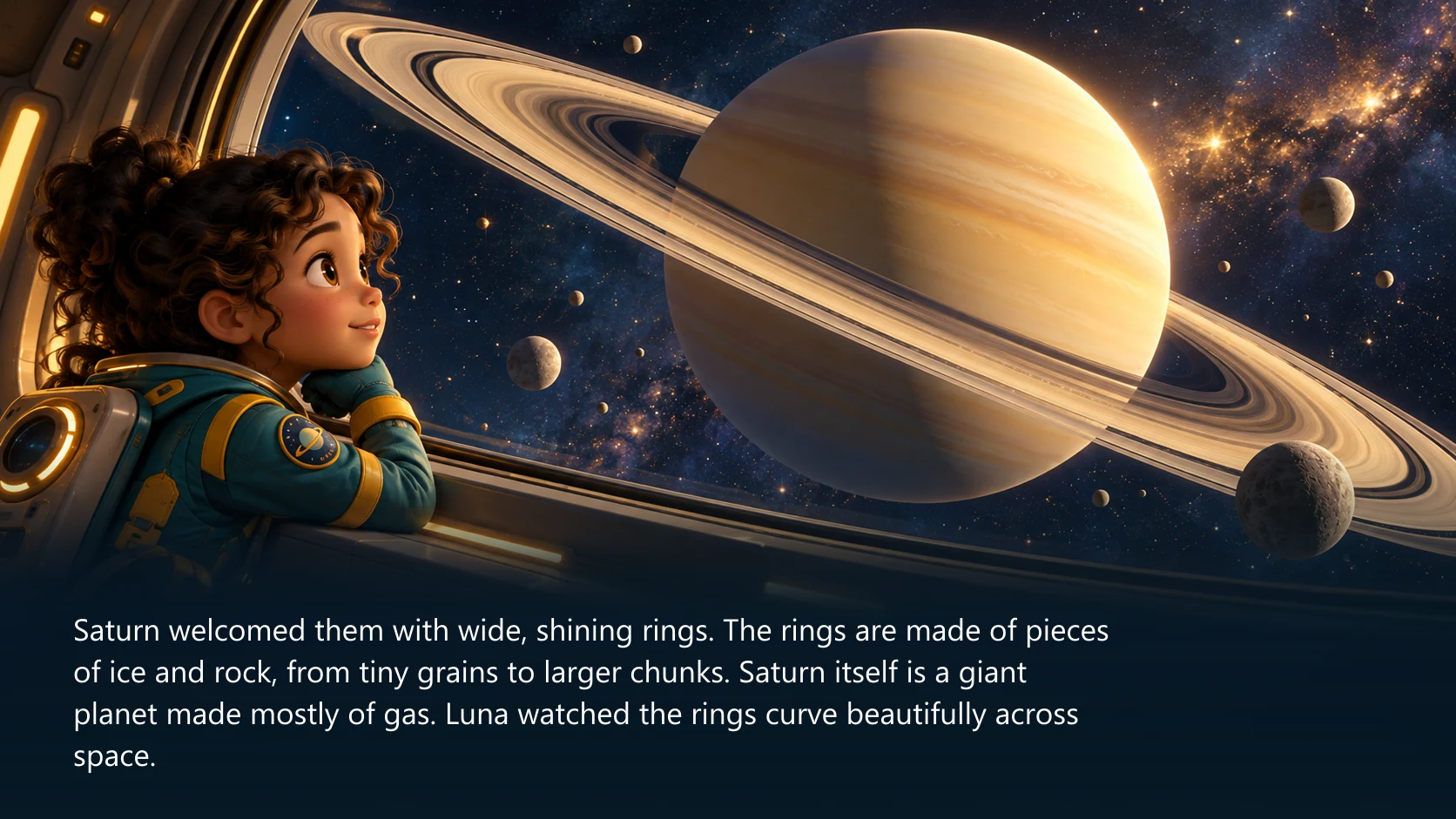
Saturn welcomed them with wide, shining rings. The rings are made of pieces of ice and rock, from tiny grains to larger chunks. Saturn itself is a giant planet made mostly of gas. Luna watched the rings curve beautifully across space.
Titan, the Hazy Moon
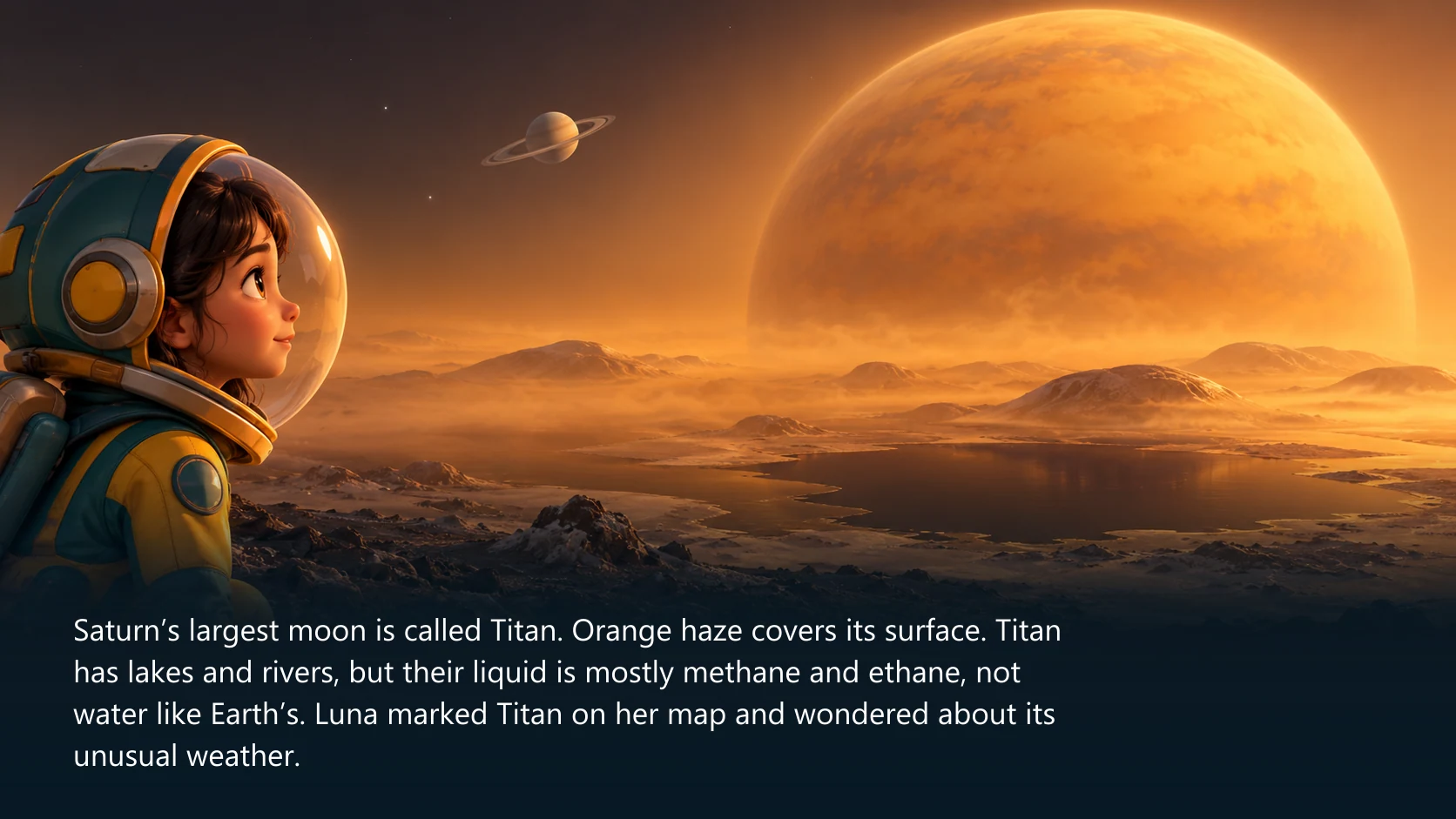
Saturn’s largest moon is called Titan. Orange haze covers its surface. Titan has lakes and rivers, but their liquid is mostly methane and ethane, not water like Earth’s. Luna marked Titan on her map and wondered about its unusual weather.
Uranus Tilts
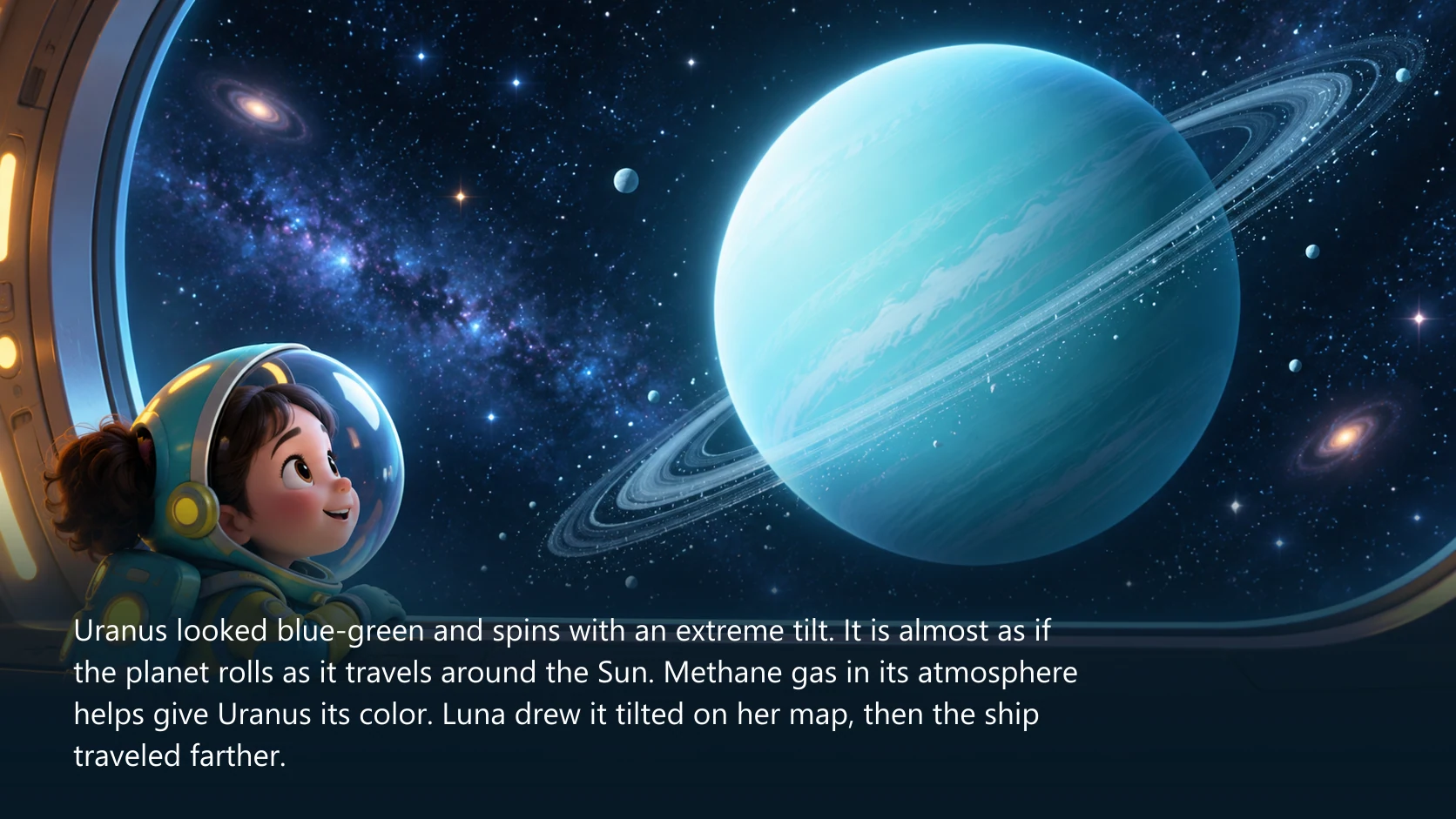
Uranus looked blue-green and spins with an extreme tilt. It is almost as if the planet rolls as it travels around the Sun. Methane gas in its atmosphere helps give Uranus its color. Luna drew it tilted on her map, then the ship traveled farther.
Distant Neptune
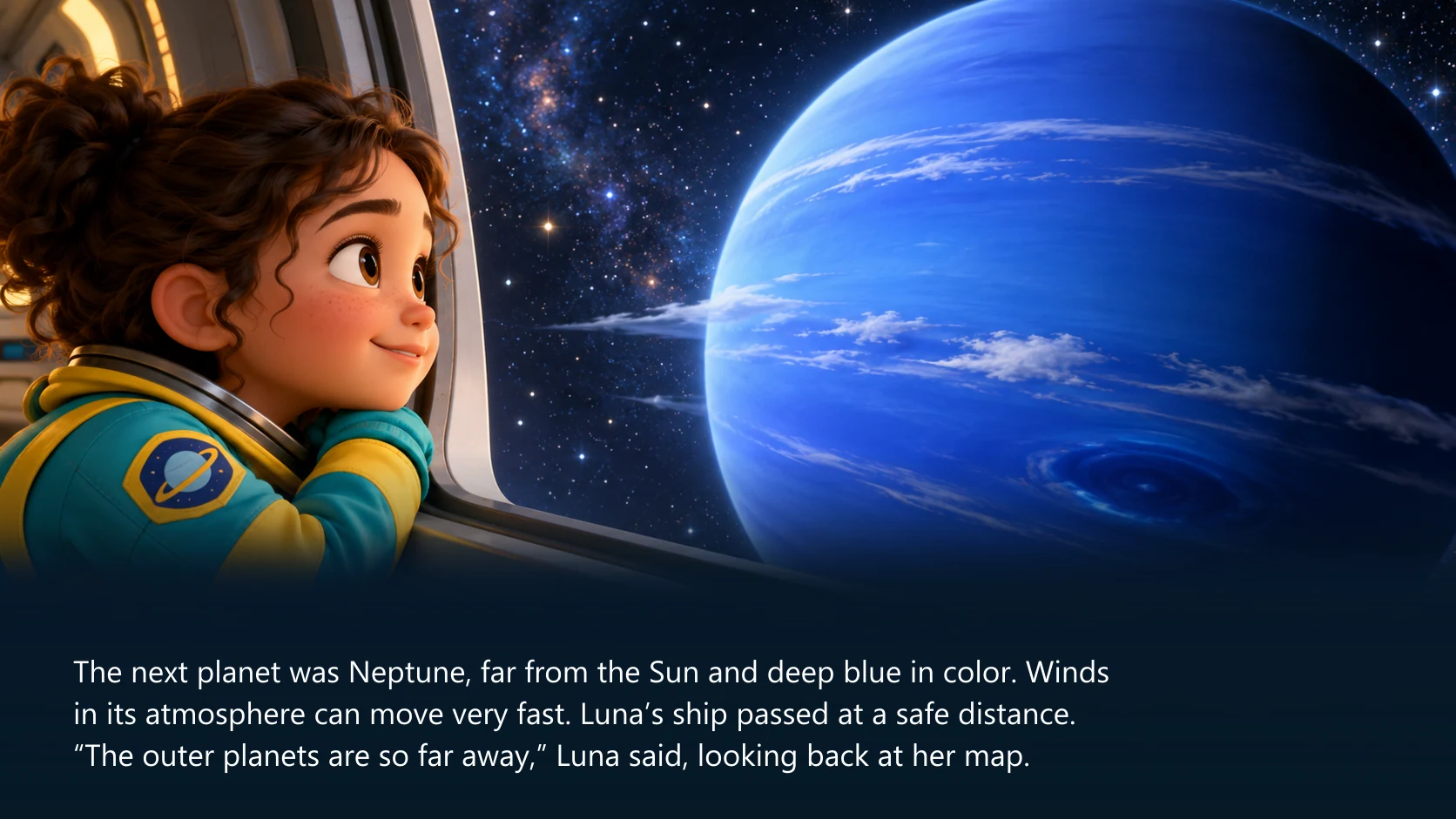
The next planet was Neptune, far from the Sun and deep blue in color. Winds in its atmosphere can move very fast. Luna’s ship passed at a safe distance. “The outer planets are so far away,” Luna said, looking back at her map.
Pluto and Charon
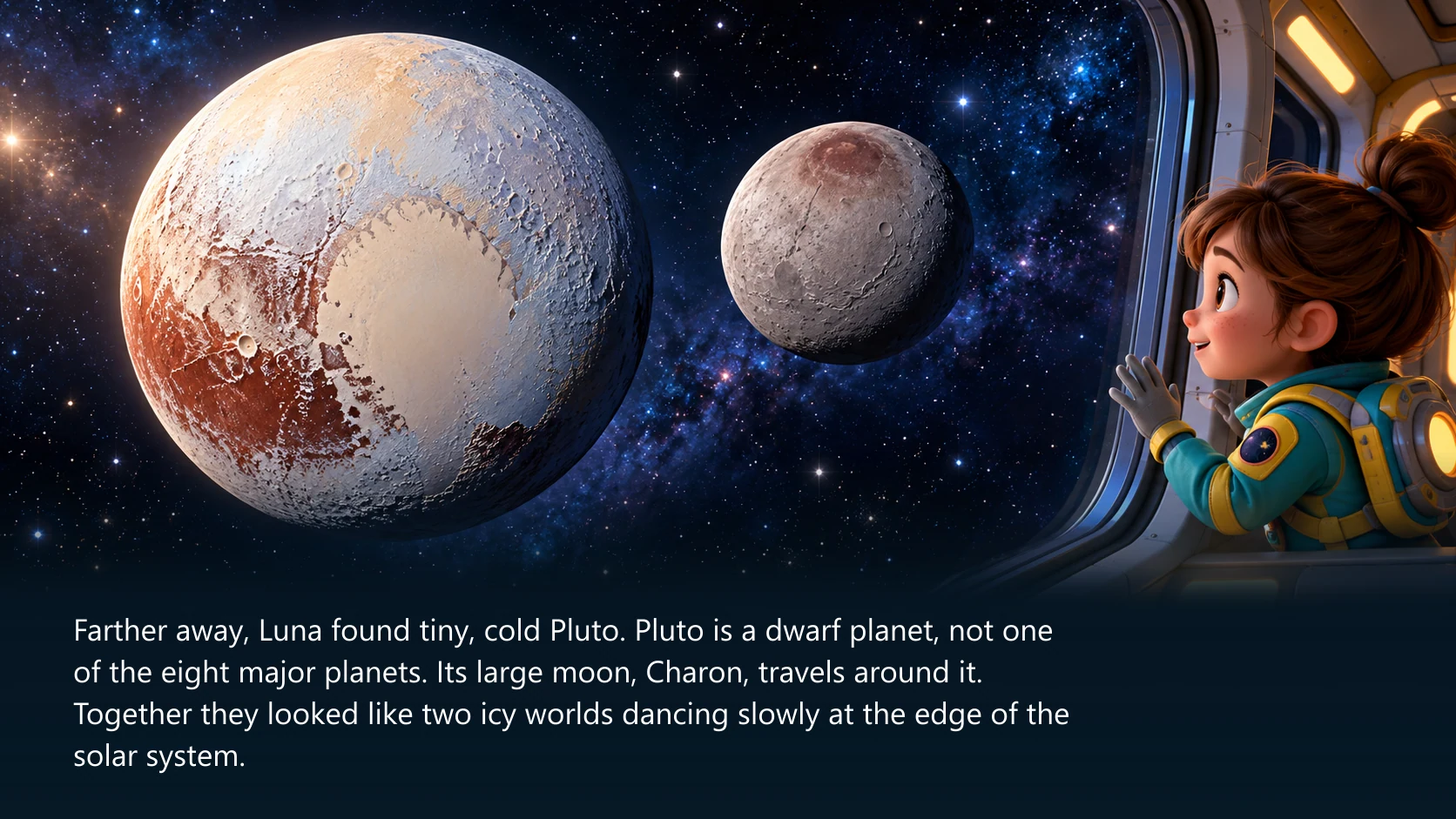
Farther away, Luna found tiny, cold Pluto. Pluto is a dwarf planet, not one of the eight major planets. Its large moon, Charon, travels around it. Together they looked like two icy worlds dancing slowly at the edge of the solar system.
A Comet with a Tail
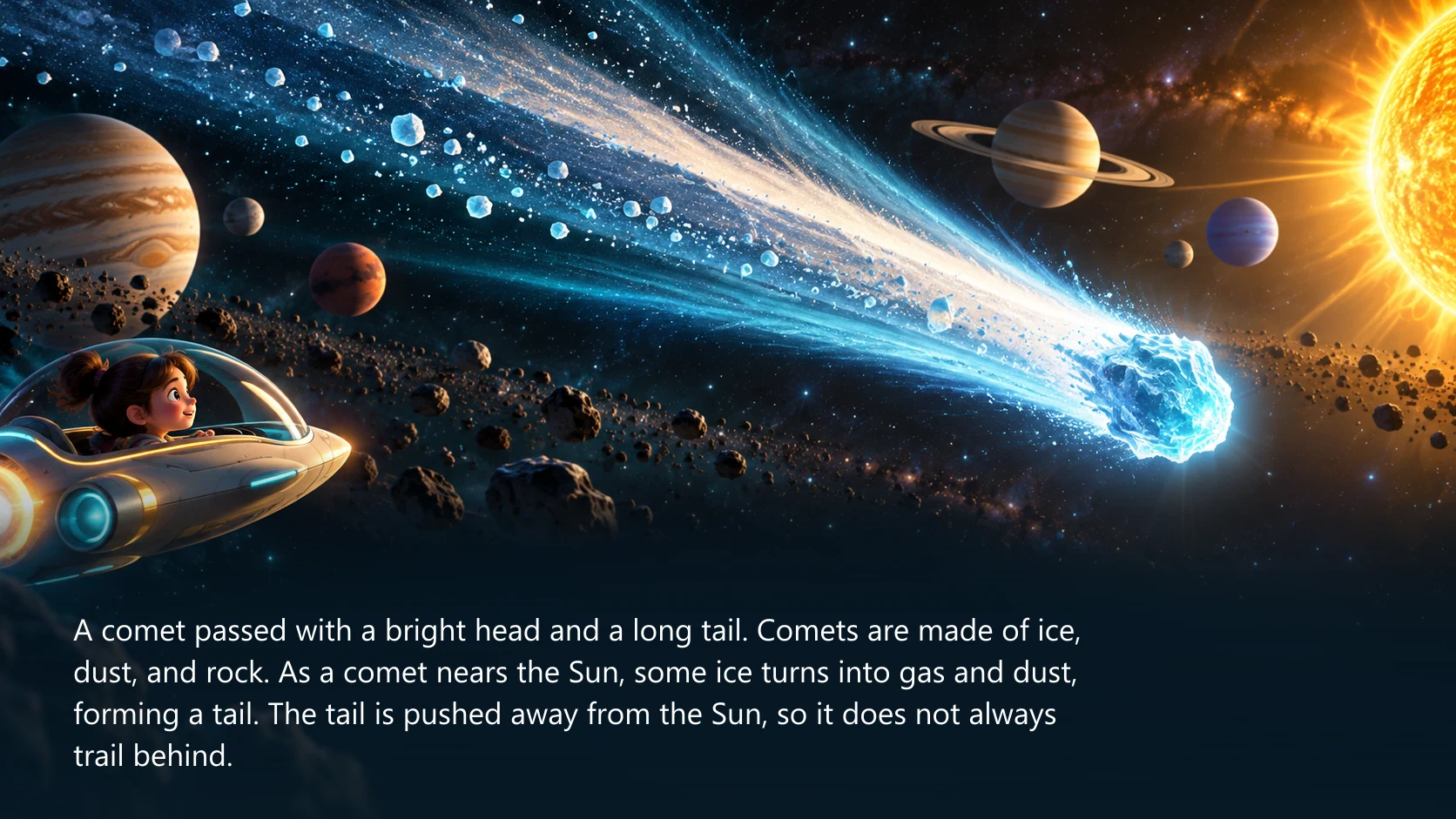
A comet passed with a bright head and a long tail. Comets are made of ice, dust, and rock. As a comet nears the Sun, some ice turns into gas and dust, forming a tail. The tail is pushed away from the Sun, so it does not always trail behind.
What Keeps Planets on Their Paths?
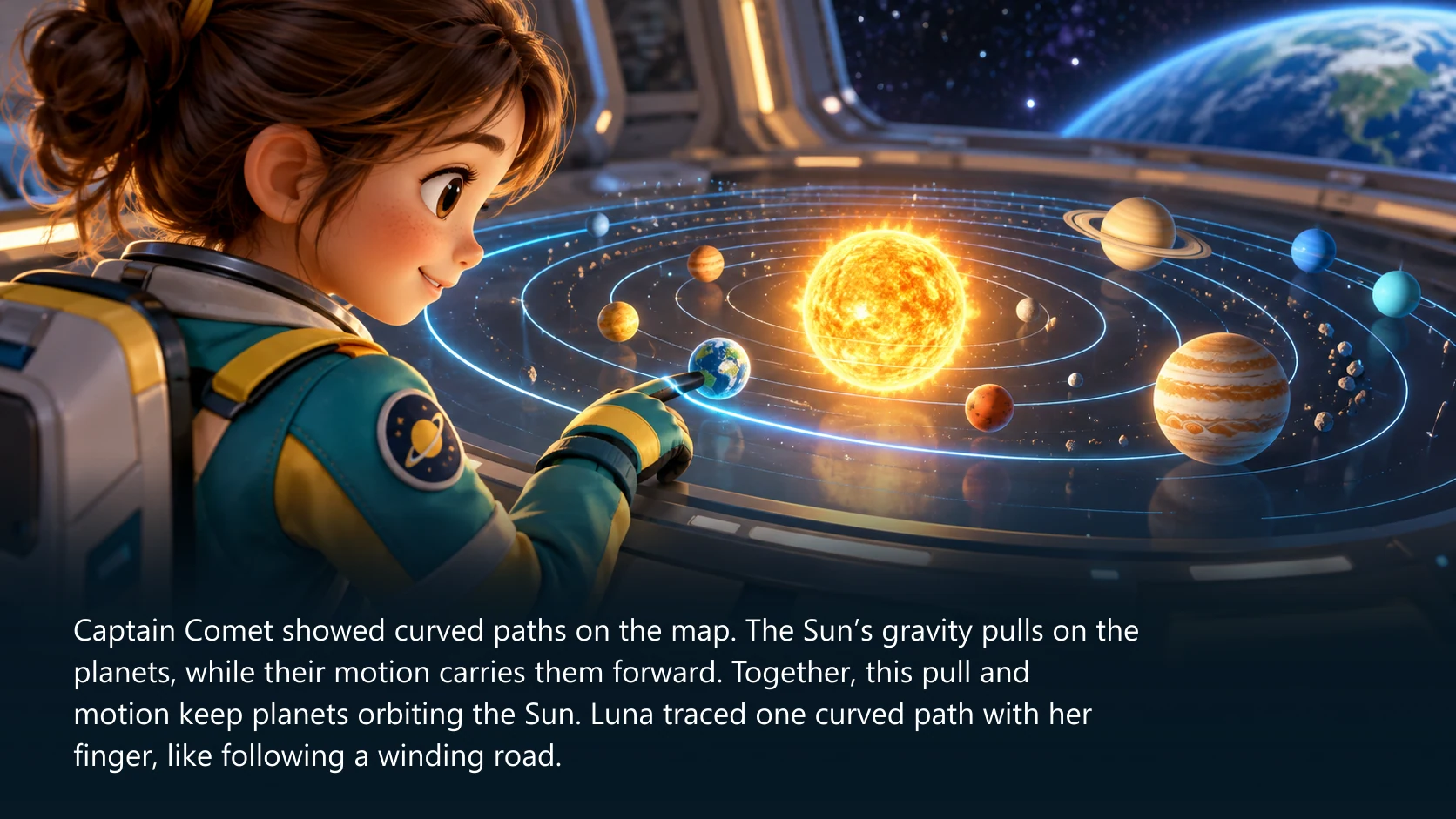
Captain Comet showed curved paths on the map. The Sun’s gravity pulls on the planets, while their motion carries them forward. Together, this pull and motion keep planets orbiting the Sun. Luna traced one curved path with her finger, like following a winding road.
The Sun and Its Planets
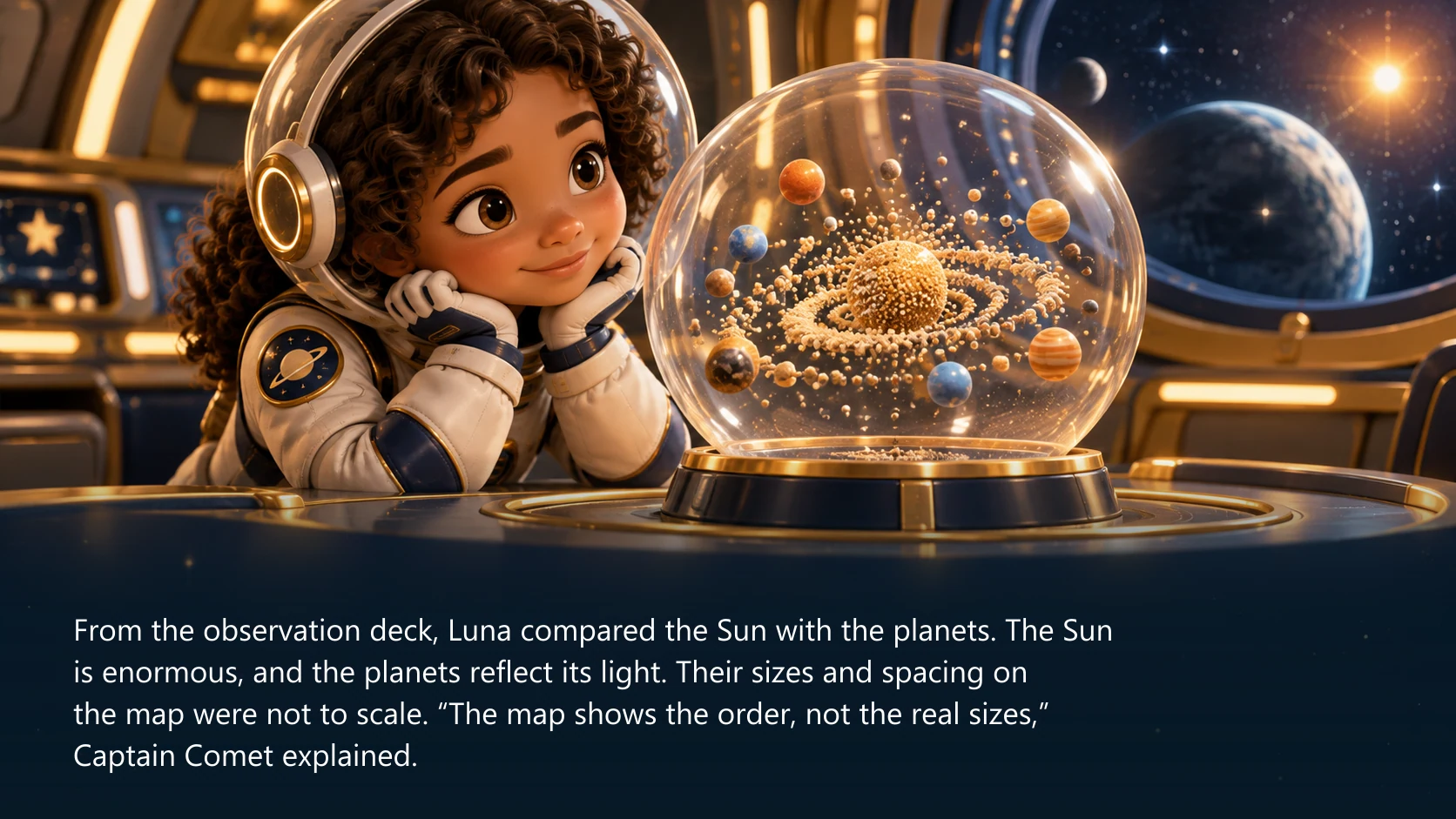
From the observation deck, Luna compared the Sun with the planets. The Sun is enormous, and the planets reflect its light. Their sizes and spacing on the map were not to scale. “The map shows the order, not the real sizes,” Captain Comet explained.
Eight Planets Around the Sun
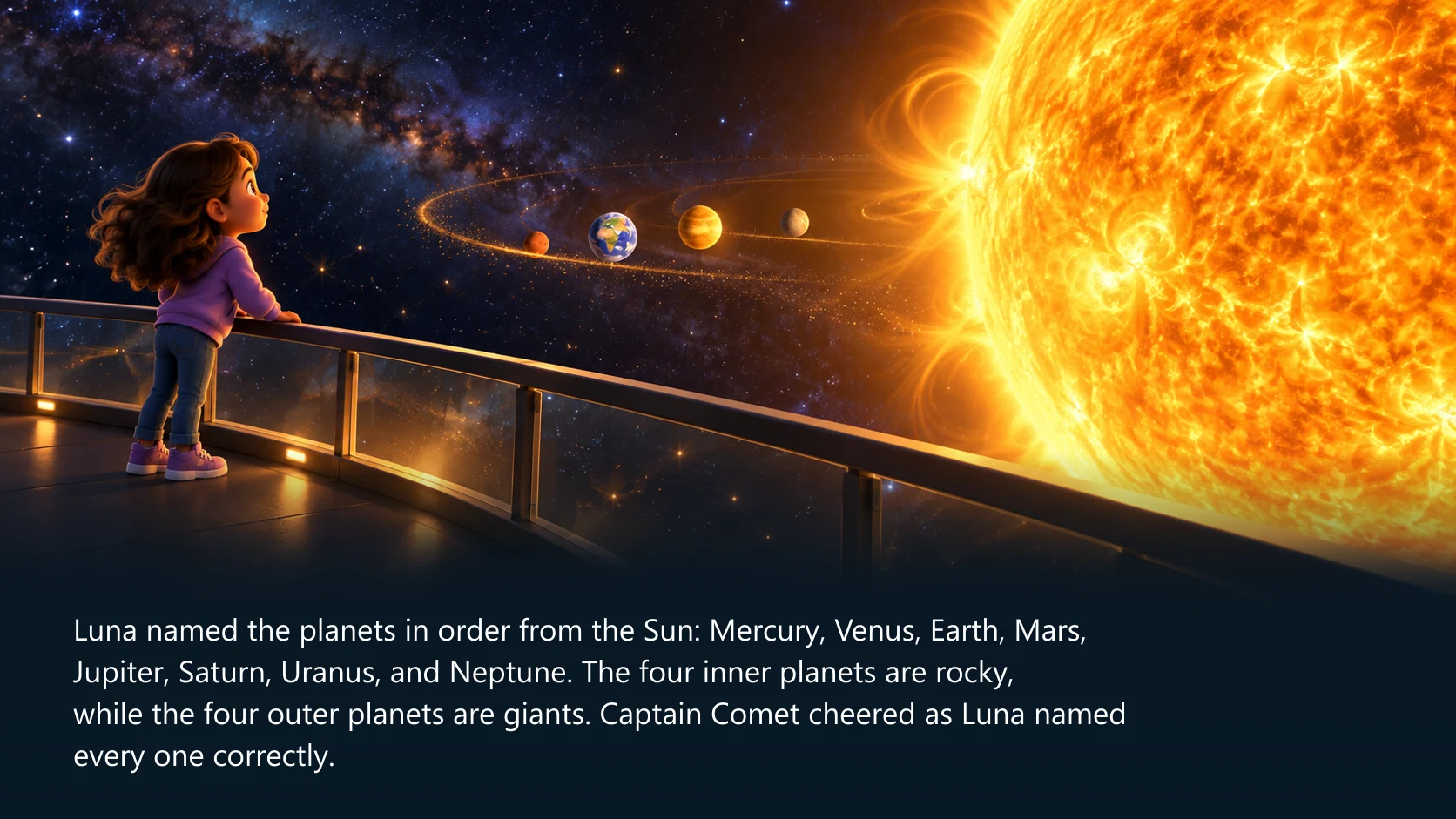
Luna named the planets in order from the Sun: Mercury, Venus, Earth, Mars, Jupiter, Saturn, Uranus, and Neptune. The four inner planets are rocky, while the four outer planets are giants. Captain Comet cheered as Luna named every one correctly.
A Big Home in Space
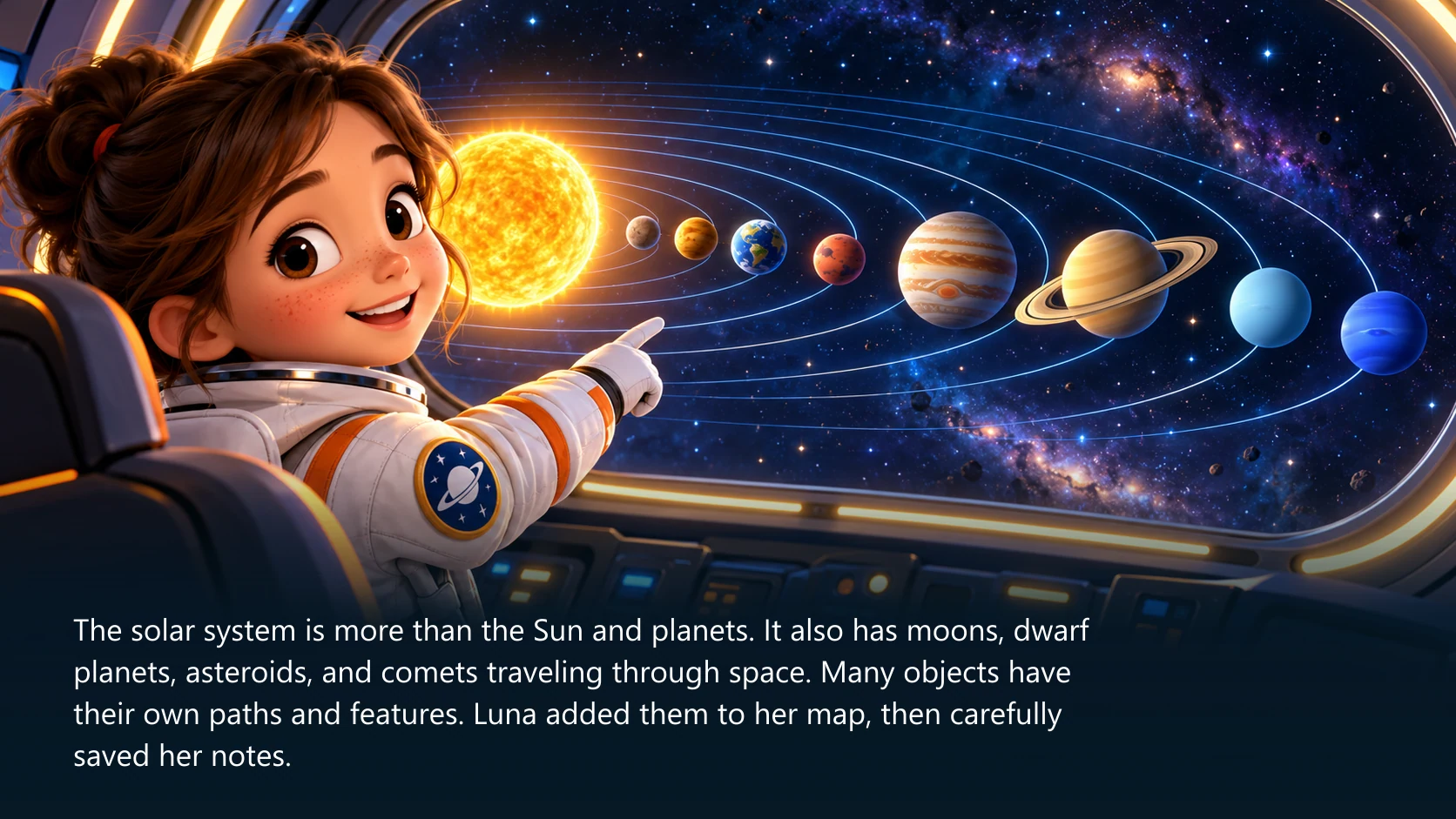
The solar system is more than the Sun and planets. It also has moons, dwarf planets, asteroids, and comets traveling through space. Many objects have their own paths and features. Luna added them to her map, then carefully saved her notes.
Home with New Discoveries
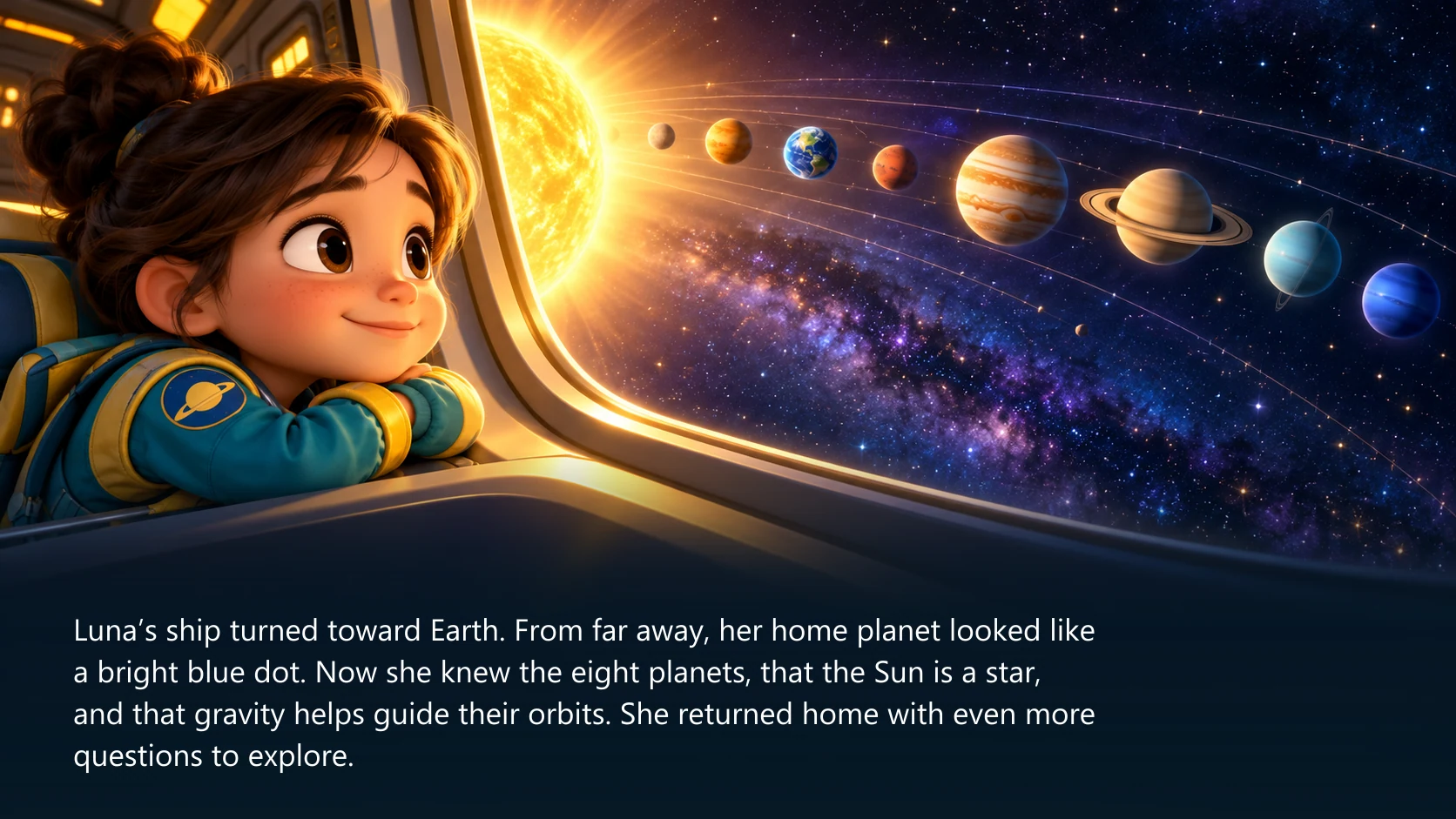
Luna’s ship turned toward Earth. From far away, her home planet looked like a bright blue dot. Now she knew the eight planets, that the Sun is a star, and that gravity helps guide their orbits. She returned home with even more questions to explore.